Data has become one of the most important resources for investment managers, banks and other financial companies, yet data is only valuable if it’s managed properly. Having systems in place that can obtain and make use of good-quality data is critical to growing both the top-and bottom-lines.
That point was highlighted at Bloomberg’s CxO Roadshow series (throughout Canada, Italy, France, Switzerland, and Belgium) where Gerard Francis, Global Head of Enterprise Data at Bloomberg spoke with financial professionals about the challenges they face getting value out of their data. Attendees expressed their frustration at overcoming the challenges associated with implementing their data strategies. Leaders expressed the need for their firms to move faster to implement the correct data strategies and architectures so they are not at a competitive disadvantage.
The problem most encountered is one of execution — implementing a forward-looking strategy is a far bigger and more complex endeavor than they had anticipated. The deeper they get into implementation, the more knowledge they need and the harder it is to achieve their desired outcomes.
“Datasets are like balls of string,” Gerard Francis explains. “There’s more and more of it that unravels without people knowing where the string actually ends. While initially, it appears that it’s a solvable problem, when companies actually go to work on it, managing data becomes a lot more difficult than they thought at the outset. It’s then that they realize the human capacity on hand is insufficient to fully solve the problem.”
The challenge of rapidly growing data
It is unsurprising that financial companies sometimes fall short in dealing with data, as it is not their core competency. Digitalization of information is a relatively recent phenomenon, and the rapid growth in the types and sheer volume of data has tripped up organizations large and small.
The ever-growing complexity and volume of data globally means that obtaining the correct nuance within each dataset is difficult. Specialized expertise in identifying, accessing and processing data is key. Without that, businesses can lose their edge.
The pursuit of data supremacy is regularly characterized as a financial arms race. The comparison is apt: without a robust, comprehensive data service, companies will find themselves behind their competitors.
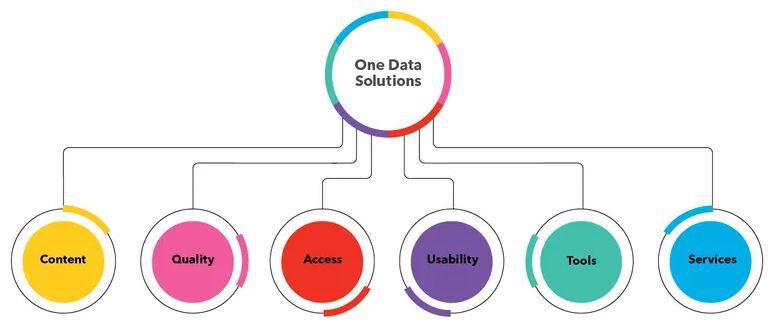
Fortunately, tackling that complexity can be simplified dramatically; the path of least resistance can be found in using a single, fully integrated primary data provider for the vast majority of data needs. Bloomberg Enterprise Data provides such an offering. Recognizing that every strand of the data gathering and processing enterprise is interlinked, Bloomberg has built its One Data solution on six core pillars: content, quality, access, usability, tools and services.
Six pillars of the data process
To illustrate the interdependence of these pillars, Francis makes a comparison between data provision and a movie-streaming app.
”When you subscribe, you are doing a few things; you are subscribing to the access methodology, which is the app on which you view movies. If you don’t have the app, you don’t get the movies,” and vice versa, he explains. “So those two things are intrinsically linked together.”
Francis extends the metaphor, saying that datasets, like movies, have to be of good quality to offer value, need technological support services, must be readily accessible in the cloud — plus, they must be presented in a way that makes them easy to navigate. The more usable the data, the less time customers have to spend deciphering it.
The same applies in a financial data setup; the information gathered has value only if it’s reliable and clean. Even then, it amounts to little if it isn’t accessible to clients or provided in a form that they find easy to use. And all of those attributes are wasted if there are no tools to tease out meaning from the constant data flow, and without systems that can keep that data updated and relevant.
The single-vendor principle offers many other immediate benefits. The common linkages that cut across all six pillars will already be in place, and that equates to savings in costs that might otherwise have been swallowed in trying to link separate infrastructures. Plus, the closer a company works with a vendor, the more synergy is generated.
Another crucial advantage of a primary-source offering is scale. Data ages and can become stale quickly – by the minute and second, in many cases. Tracking changes in existing datasets and monitoring new and emerging feeds is a full-time task in itself. Once a data strategy is established, it’s not enough to assume the setup can run itself; data has to be constantly monitored, a challenge that has affected even the largest banks.
Pulling together multiple data sources
Bloomberg has the scale not only to keep the datasets it offers current and relevant but also to seek out and obtain data that might be of use in the future. Clients can browse a dedicated web-based marketplace, Enterprise Access Point, and access 500+ products and 6000+ datasets.
As well as providing many thousands of standard and alternative data sources, Bloomberg works closely with hundreds of third-party vendors in order to source an even wider high quality content pool.
The events of the last year have accelerated the adoption of the cloud in the financial services industry. Bloomberg recognized this inevitable shift a few years ago and as a result of that foresight, a number of Enterprise Data solutions were already accessible via a cloud-based web-supported platform before the coronavirus pandemic transformed the way the world works. This means clients were able to benefit from high-quality, fast data feeds even during the weeks of unprecedented economic disruption and remote work.
Bloomberg’s expertise, built over decades of data generation and provision, underpins the One Data offering. Every day, a team of engineers, analysts and data scientists support clients as they build strategies to give them an edge in what is undoubtedly the most important input into their enterprise.
“The most important thing we do is that we make our data offering both broad and deep,” Gerard Francis says. “Clients know that by coming to one place, they get everything and it will just work.”